Quantum Computing (QUBT.US) Price Target 2026/2027: 135% Upside – Rating and Stock Analysis

7.89
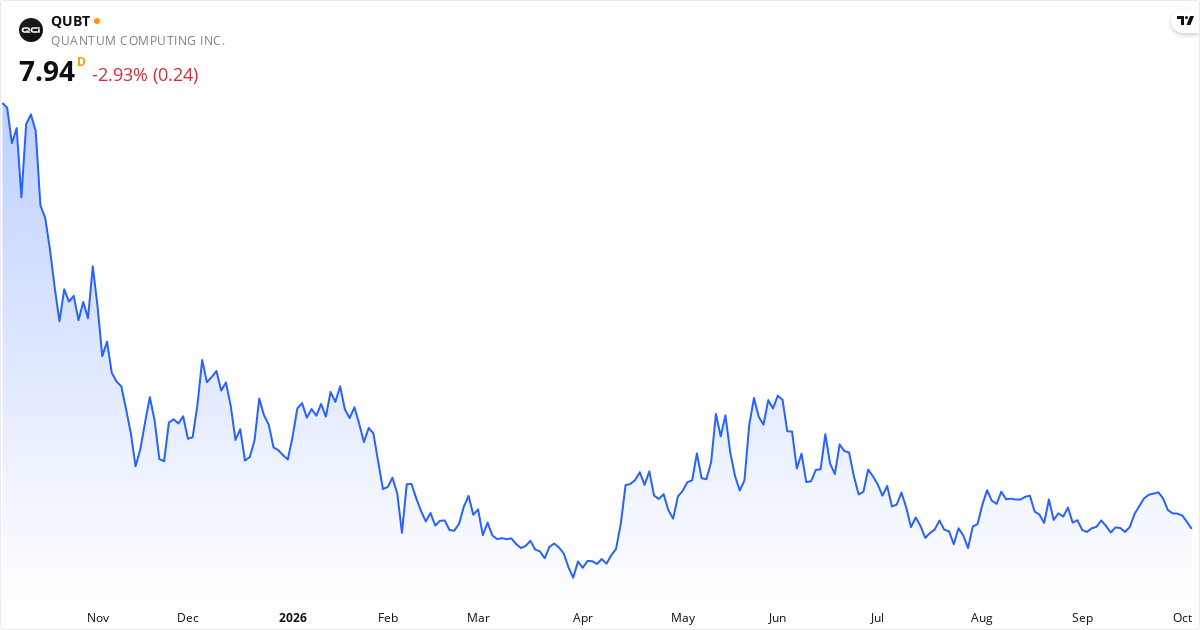
Price history for Quantum Computing (QUBT.US) – stock price at $7.89, October 2026
Quantum Computing stock price – price development 2026. Updated Oct 7, 2026.
Share this analysis:

Quantum Computing Price Target 2026: Analysts See 137% Upside

The average price target for Quantum Computing is $18.67. This price target represents the analysts' view of the stock price over the next 12 months. The stock may be undervalued, because the price target is higher than the current price. The stock is 136.63% below the target, which can point to potential returns within the next 12 months if the analysts' view proves right. Also consider the stock's valuation ratios such as P/E, P/S and P/B, plus the technical analysis further down the page, for the full picture.

Is Quantum Computing overvalued or undervalued?

Quantum Computing is currently undervalued with a gap of 136.6% relative to the price target.


The current price is $7.89, which places Quantum Computing in the undervalued category. The stock is considered undervalued when the price is below $16.80, and overvalued when the price exceeds $20.54.


The fair value range is defined as ±10% of the price target, because price targets are estimates rather than exact values. For Quantum Computing, the fair value range lies between $16.80 and $20.54.


See the full price target analysis for Quantum Computing →

Analyst Ratings for Quantum Computing stock in 2026: Buy

6 analysts cover Quantum Computing. The majority is positive, with 66.7% recommending Buy, while 33.3% recommend Hold. The average price target is $18.67, which gives an upside of 136.6% from the current price.

Consensus: Buy (4.33/5)
Strong Buy
4 (66.7%)
Hold
2 (33.3%)
Strong Sell Sell Hold Buy Strong Buy
4.33 out of 5 based on 6 analysts

About Quantum Computing – Computer Hardware

Quantum Computing Inc. (qubt.us) develops software and tools for quantum computers. The company makes money by selling these solutions to both business customers and government agencies.

Its main product is called Qatalyst. This is a tool that lets software developers build and test quantum computing programs on regular computers, before moving them to an actual quantum computer. A quantum computer is a special type of computer that can solve certain complex problems much faster than normal computers. Qatalyst works with several different types of quantum computers, including ones made by DWave, Rigetti and IonQ.

The company was founded in 2018. It is based in Leesburg, Virginia, in the United States. It was previously known as Quantum Computing, Inc.
Read more about the company

Key Figures for Quantum Computing

$1.8B Market cap
$9.8M Revenue
Computer Hardware Industry
- P/E
182.94 P/S
1.29 P/B
United States Listed on exchange

What kind of stock is Quantum Computing?

Speculative stock

Quantum Computing is classified as a speculative stock.

Score Overview for Quantum Computing

💰 Value Score 22/100 (Low)
⭐ Quality Score 2/100 (Very Low)
🚀 Momentum Score 8/100 (Very Low)
📊 Total Score 10/100

⚠️ 4 red flags identified 3 critical

Our analysis has identified 4 potential risk factors in Quantum Computing that investors should be aware of.

🚨 Weak financial health: The Piotroski score is only 1/9 – the company shows signs of weakened profitability, liquidity or capital structure.
🚨 Negative profit margin: The profit margin is -152.5% – the company is losing money on its operations.
⚠️ Negative return on equity: ROE is -1.5% – the company is generating a negative return for shareholders.
🚨 High short interest: 32.3% of the shares are sold short – many professional investors are betting on price declines.

📈 Valuation

The P/S ratio is 182.9 (high — the market pays a premium for the revenue). The P/B ratio is 1.3.

🏦 Financial Health

The Piotroski score is 1 out of 9 — weak financial health, be careful. Altman Z2 is 38.79 (healthy balance sheet — low risk). The debt-to-equity ratio (D/E) is 43.1% — low debt, a solid balance sheet.

🚀 Momentum & Short Interest

Short interest is 32.31% — very high, the market is skeptical.

Insider Trading in Quantum Computing 2026: The Signal Is negative

In 2026, insiders at Quantum Computing have made 20 transactions, all of which were sales. On a net basis, insiders took $8,153,121 out of the stock. Active insiders include Roberts Christopher Bruce, Christopher Bruce Roberts, Milan Begliarbekov and others.

Short-Term Signal (3 months): No activity

There has been no insider trading in the last 3 months.

Long-Term Signal (all transactions): Negative

Insiders have exclusively sold shares in the recent period. This can suggest management sees limited opportunity.

Across the last 20 transactions: 0 purchases and 20 sales. A net $8,153,121 out of the stock.

Latest sale: Roberts Christopher Bruce sold 9,360 shares at $7.85 each on 2026-03-11.

Who is selling: Roberts Christopher Bruce, Christopher Bruce Roberts, Milan Begliarbekov, Begliarbekov Milan, Robert B Fagenson and others.

Latest Insider Trades in Quantum Computing (2026)

The table shows the last 20 reported insider transactions in Quantum Computing. Green rows are purchases, red rows are sales. The data is based on official filings.

Transaction date Name Type Number of shares Price per share ($) Total amount ($)
2026-03-11 Roberts Christopher Bruce Sell 9,360 8 73,476
2026-03-11 Christopher Bruce Roberts Sell 9,360 8 73,476
2026-03-10 Roberts Christopher Bruce Sell 400,000 8 3,140,000
2026-03-10 Christopher Bruce Roberts Sell 68,902 8 540,881
2026-01-07 Milan Begliarbekov Sell 2,860 12 33,891
2026-01-07 Begliarbekov Milan Sell 2,860 12 33,891
2025-09-15 Robert B Fagenson Sell 5,000 17 84,400
2025-09-15 FAGENSON ROBERT B Sell 5,000 17 84,400
2025-09-12 Robert B Fagenson Sell 15,000 16 234,300
2025-09-12 FAGENSON ROBERT B Sell 15,000 16 234,300

Who is buying and selling Quantum Computing shares in 2026?

The following insiders have sold shares: Roberts Christopher Bruce, Christopher Bruce Roberts, Milan Begliarbekov, Begliarbekov Milan, Robert B Fagenson and others. In total, $8,153,121 was sold across 20 transactions. Insider trades are legal transactions in which executives and board members buy or sell shares of their own company. These transactions are reported to the SEC and are publicly available.

Quantum Computing Short Selling 2026: 32.3% Sold Short

Extremely shorted: 32.3% of the free float
Short % of free float
32.3%
Assessment
Extremely shorted
Short squeeze risk
Very High
Data source
EODHD
Reported about twice a month

Short interest over time: Quantum Computing

0.0%18.6%37.3%
5/307/219/12
32.3% today (extremely high)Last 30 days: +0.3 percentage pointsMeasured over 105 days
What does the trend tell you?
Short interest in Quantum Computing has been fairly stable at 32.3% over the period. Neither many new short sellers have arrived nor many positions been closed.

What matters is when the curve starts to move. This is how shorting works: whoever shorts has borrowed the share and sold it, and to close the position again they must buy the share back. When short interest falls, shares are being bought back. So it is worth watching the trend, not just today's number.
The stock has an extremely high share of short selling. More than 20% of the freely traded shares are sold short, which is unusual and can point to great skepticism among institutional investors. The risk of a short squeeze on positive news is considerable.

What does this mean for you as an investor?
A short interest of 32.3% means that 32.3% of the freely traded shares in Quantum Computing have been borrowed and sold by investors betting on falling prices. On positive surprises (e.g. a strong earnings report), short sellers can be forced to buy back shares quickly to close their positions, which can cause a short squeeze with sharp price gains in a short time.

The next potential catalyst is the earnings report on Nov 13, 2026. With a short interest of 32.3%, the report can trigger considerable volatility.

Short interest comes from our data provider EODHD. The figure is reported about twice a month; we check it every trading day.
Short Interest Scale
0% 2% 5% 10% 20%+
Low Moderate High Very High Extreme
▲
32.3%

When Does Quantum Computing Report Earnings – Next Date: Nov 13, 2026

The next earnings report from Quantum Computing is scheduled for November 13, 2026. This report covers the third quarter (Q3), which ended on September 30, 2026.


Technical Analysis of Quantum Computing 2026 – Signal: Strong Sell

Overall Technical Signal: Strong Sell

Based on trend analysis (SMA50/SMA200) and MACD trend (positive/negative on a daily + weekly basis). Updated October 7, 2026.

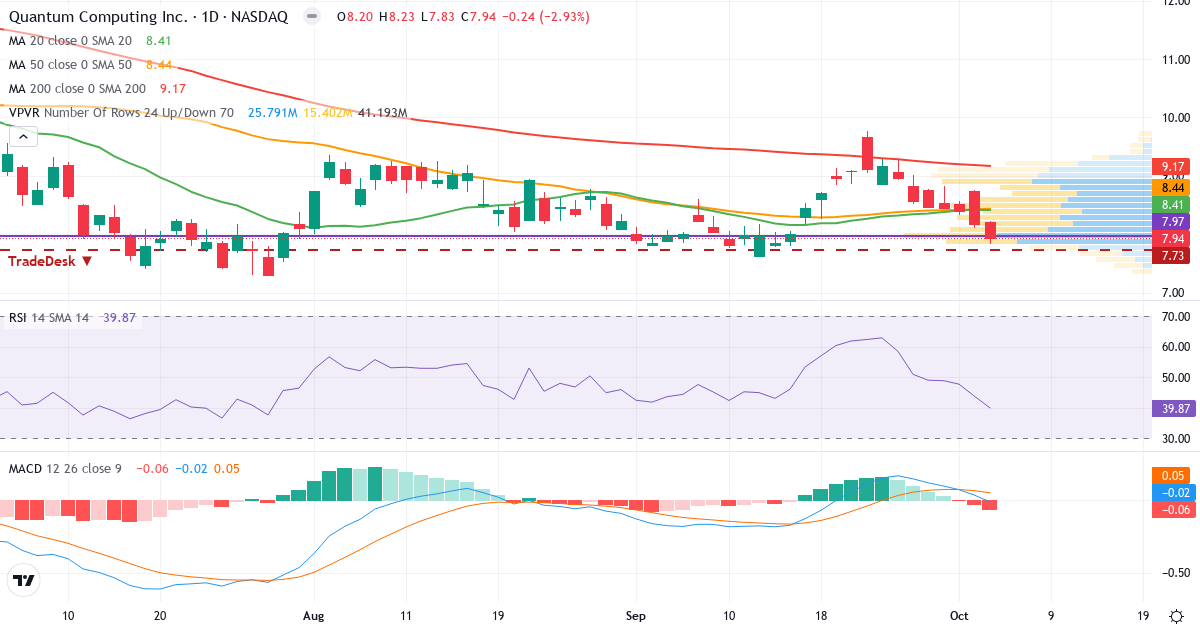
Technical analysis of Quantum Computing (QUBT.US) – RSI 39, MACD negative (bearish), daily candlestick chart October 2026
Quantum Computing technical analysis – candlestick chart with RSI, MACD and volume profile. Updated Oct 7, 2026.

Trend Analysis of Quantum Computing Inc

Quantum Computing Inc is in a short-term downtrend. The price of $7.86 is 6.4% below the 20-day average ($8.40). Medium term, the picture is negative: the price is 6.8% below the 50-day average ($8.43). Long term, the stock is 14.2% below the 200-day average ($9.16), which signals a long-term downtrend.

Death Cross: The 50-day average (8.43) is below the 200-day average (9.16), which is a classic bearish signal for Quantum Computing Inc.

Is Quantum Computing Inc overbought or oversold?

Quantum Computing Inc has an RSI of 38.6. The stock sits in the lower part of the neutral zone, which points to weak momentum without being oversold. In the current downtrend, be careful about reading this as a buying opportunity.

MACD Analysis for Quantum Computing Inc

Daily MACD: MACD is negative (-0.060), which means the short-term trend is bearish (the 12-day EMA is below the 26-day EMA). MACD is below the signal line (0.025) by 0.085, which confirms growing negative momentum in the downtrend.

Weekly MACD: MACD5 is negative (-0.487), which indicates a broader bearish long-term trend. MACD5 is above the signal line (-0.539) by 0.052, which suggests the negative long-term momentum is fading – a bigger trend reversal could be ahead.

Overall MACD assessment: Both the daily and weekly trend are bearish (MACD negative). However, momentum shows signs of improving on a weekly basis – a potential trend reversal could be ahead, but it is not confirmed yet.

Risk Profile for Quantum Computing Inc

Quantum Computing Inc has an annual standard deviation of 91.4%, which classifies the stock as Extremely speculative. Only risk-tolerant investors should consider this stock, because the price swings can be very large.

Overall Technical Conclusion for Quantum Computing Inc

Trend: Negative. The price trades below SMA50 and SMA200.

MACD trend (zero line): Daily bearish (-0.060). Weekly bearish (-0.487).

MACD momentum (signal): Daily falling. Weekly rising.

RSI: 38.6 – neutral.

Technical signal: Strong Sell

The price is in a downtrend (below SMA50/SMA200) and MACD is negative on both a daily and weekly basis. Avoid buying and consider closing existing positions.

Frequently Asked Questions About Quantum Computing stock in 2026

Should you buy Quantum Computing stock now?
No, the technical signal for Quantum Computing is currently Strong Sell. Quantum Computing trades at $7.89 as of Oct 7, 2026. The technical analysis shows the following: MACD is negative (bearish trend) at -0.060 with falling momentum (signal: 0.025); RSI is at 38.6 (neutral zone); the stock is in a short-term downtrend (price below the 20-day average); the analyst price target of $18.67 points to 136.6% upside. The stock is in a broader downtrend (below SMA50/SMA200). Buying in a downtrend is generally not recommended. This is a technical observation based on current data, not investment advice.
What is the price target for Quantum Computing stock?
The average analyst price target for Quantum Computing is $18.67. The current price is $7.89, which gives an upside of 136.6%. Based on this, the stock is considered undervalued. The fair value range (±10% of the price target) is between $16.80 and $20.54.
Is Quantum Computing a dividend stock?
No, Quantum Computing does not currently pay a dividend to shareholders. The company reinvests its profits in growth instead of paying dividends.
What is the risk of Quantum Computing stock?
Quantum Computing is rated as a stock in the risk category Extremely speculative. the annual standard deviation is 91.4%, which classifies the stock as Extremely speculative.
Is Quantum Computing overvalued?
No, Quantum Computing is considered undervalued based on the analyst price target (136.6% upside). Quantum Computing has the following valuation ratios: a P/S ratio of 182.9, a P/B ratio of 1.3. The analyst price target suggests that the stock is undervalued by 136.6%.
Is Quantum Computing overbought?
No, Quantum Computing is not overbought. RSI is at 38.6 (neutral zone). The technical indicators show: RSI is at 38.6 (neutral zone between 30-70), which signals neither overbought nor oversold. In addition, the price is 6.0% below the 20-day average (short-term downtrend). In addition, MACD is negative with falling momentum (bearish).
When is the next Quantum Computing earnings report?
Quantum Computing reports its next earnings on November 13, 2026. The stock currently trades at $7.89.
Is Quantum Computing shorted?
Yes, Quantum Computing is shorted with 32.3% of the free float sold short. This is an extremely high level of short selling, which points to great skepticism among institutional investors. The risk of a short squeeze on positive news or earnings is very high. The figure comes from our data provider EODHD, is reported about twice a month, and we check it every trading day.
Are insiders buying Quantum Computing stock?
No, insiders are not buying Quantum Computing shares – they are net sellers. Across the last 20 reported transactions, the split is 0 purchases and 20 sales, with a net 8,153,121 $ sold. Active sellers include Roberts Christopher Bruce, Christopher Bruce Roberts, Milan Begliarbekov and others. Insider selling can have several explanations (e.g. planned 10b5-1 sales, portfolio diversification or taxes), but sustained selling by several insiders is worth watching closely.
Is Quantum Computing a good stock?
Based on our total score, Quantum Computing is rated as a disastrous stock with a total score of 10 out of 100. The stock scores very low on value, quality and momentum – it is among the worst in our database. The score is made up of Value: 22/100, Quality: 2/100, Momentum: 8/100. In addition: analysts see 136.6% upside to the price target; technical signal: Strong Sell. Whether Quantum Computing is a good investment depends on your time horizon, risk profile and portfolio. This is a data-driven observation, not investment advice.
What is the outlook for Quantum Computing stock?
The outlook for Quantum Computing based on current data: the average analyst price target is $18.67 (+136.6%); the stock is in a downtrend (below SMA50 and SMA200); the next earnings report is due on Nov 13, 2026, which can move the price. Keep in mind that stock prices are affected by many factors, including earnings reports, the economy and market sentiment. Past returns are no guarantee of future returns.
Why is Quantum Computing stock falling?
Quantum Computing is falling right now. The technical indicators show: the price is 6.0% below the 20-day average; MACD is negative with falling momentum (bearish signal); short interest is 32.3% (high – many are betting on a decline); insiders have mostly been selling the stock recently. For the latest context, see our technical analysis and insider section above.
How high can Quantum Computing go?
The average analyst price target for Quantum Computing is $18.67, which corresponds to a potential gain of 136.6% from the current price of $7.89. The stock has traded between $6.18 and $23.79 over the last 52 weeks. The price is 66.8% below the 52-week high, which can indicate potential if the underlying fundamentals are intact. Keep in mind that price targets are estimates, not guarantees. Actual price moves depend on earnings, market conditions and unexpected events.
How low can Quantum Computing fall?
The stock has traded as low as $6.18 over the last 52 weeks — that is 21.7% below the current price of $7.89. The biggest decline (drawdown) in the same period was 74.0% from high to low. Within a year, the price typically swings about ±91.4% (standard deviation — a measure of price swings). A difficult year could therefore mean a further decline of that size. Remember: past price swings are no guarantee for the future — a stock can fall further than the last 52 weeks suggest, especially on profit warnings, sector crises or a market crash. Use stop-loss orders and spread your portfolio to limit losses in single stocks.
What does Quantum Computing do?
Quantum Computing Inc. (qubt.us) develops software and tools for quantum computers. The company makes money by selling these solutions to both business customers and government agencies. Its main product is called Qatalyst. This is a tool that lets software developers build a... The company belongs to the Technology sector, more specifically the Computer Hardware industry, is headquartered in United States, and is traded on the USA Stocks. See the key figures, earnings history and price development above to evaluate Quantum Computing as an investment.
Did Quantum Computing raise or lower its guidance?
Over the last 60 days we have not registered a guidance raise or cut from Quantum Computing. The company can still adjust its guidance at quarterly reports or between reports — see the earnings history above.
Is Quantum Computing making money or losing money?
No, Quantum Computing is currently not making money — the company is losing money with a negative profit margin of -152.5%, a substantial loss. That means the business loses money on every dollar of revenue. For growth stocks investing in expansion this is normal — but it raises the risk if the company does not reach break-even before its capital runs out.
Can Quantum Computing go bankrupt?
The bankruptcy risk of Quantum Computing is rated as low. Altman Z2 (a model for assessing financial distress) is 38.79 — that places the company in the healthy zone. The company has a healthy balance sheet with limited debt relative to earnings and assets. The Piotroski score (financial health 0-9, higher is better) is 1 — which is weak. Debt relative to equity is 43% (low). Remember: models like Altman Z2 are statistical — unexpected shocks (fraud, a sector collapse, lawsuits) can always happen. Spread your portfolio.
Does Quantum Computing have a lot of debt?
No, Quantum Computing has low debt relative to equity. The debt-to-equity ratio (D/E — interest-bearing debt to equity) is 43%. For the technology sector, anything below 60% counts as low debt. Tech companies are usually asset-light and need little borrowed capital — anything below 60% counts as low in this sector. Note: D/E levels are highly sector-specific — a bank at 300% debt is normal, a tech stock at 300% is extremely leveraged. Always compare with similar companies in the same sector.
Other Stocks in Technology

Compare Quantum Computing with other stocks in the technology sector. Click a stock to see its technical analysis, insider trading and key figures.

See all 204 stocks in the Technology sector