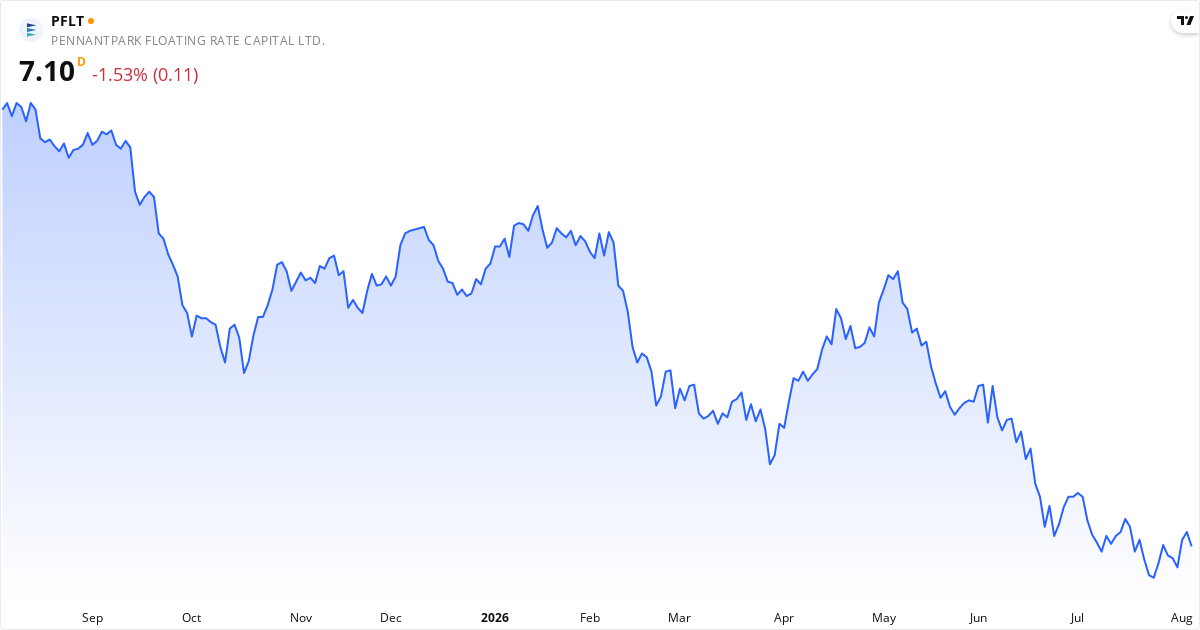
Should you buy PennantPark Floating Rate Capital stock now?
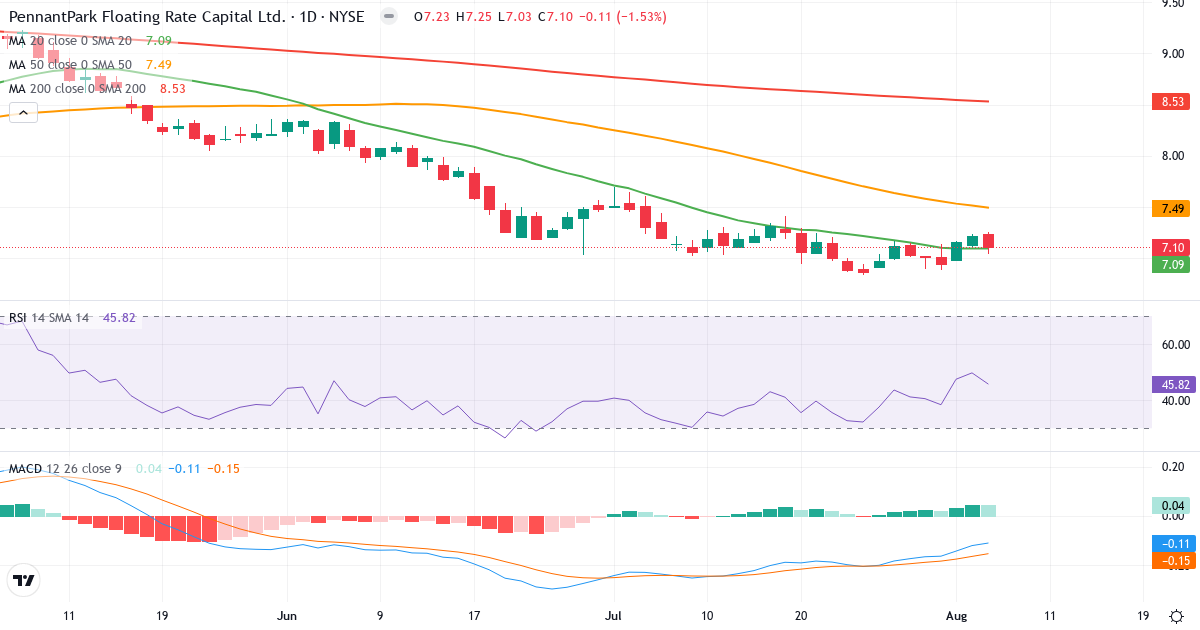
No, the technical signal for PennantPark Floating Rate Capital is currently SELL. PennantPark Floating Rate Capital trades at $7.31 as of 8/6/2026. The overall technical signal is: Strong Sell. The technical analysis shows the following: MACD is negative (bearish trend) at -0.084 with rising momentum (signal: -0.123); RSI is at 47.2 (neutral zone); the stock is in a short-term uptrend (price above the 20-day average); the analyst price target of $10.08 points to 37.9% upside. The stock is in a broader downtrend (below SMA50/SMA200). Buying in a downtrend is generally not recommended. This is a technical observation based on current data, not investment advice.
What is the price target for PennantPark Floating Rate Capital stock?
The average analyst price target for PennantPark Floating Rate Capital is $10.08. The current price is $7.31, which gives an upside of 37.9%. Based on this, the stock is considered undervalued. The fair value range (±10% of the price target) is between $9.07 and $11.09.
Is PennantPark Floating Rate Capital a dividend stock?
Yes, PennantPark Floating Rate Capital is a dividend stock with a dividend yield of 17.20%. The latest dividend was $0.08 per share. The latest ex-dividend date (traded without the dividend) was 7/15/2026. The payout ratio is 45.9%, which is considered sustainable. The next dividend payment is scheduled for 8/3/2026.
When does PennantPark Floating Rate Capital pay a dividend in 2026?
PennantPark Floating Rate Capital pays its next dividend on 8/3/2026. The latest dividend was $0.08 per share with an ex-dividend date of 7/15/2026. The dividend yield is 17.20%. The payout ratio of 45.9% points to a sustainable dividend with room to grow.
What is the risk of PennantPark Floating Rate Capital stock?
PennantPark Floating Rate Capital is rated as a stock with low risk. the annual standard deviation is 22.3%, which classifies the stock as low risk.
Is PennantPark Floating Rate Capital overvalued?
No, PennantPark Floating Rate Capital is considered undervalued based on the analyst price target (37.9% upside). PennantPark Floating Rate Capital has the following valuation ratios: a P/E ratio of 11.4 (moderately valued), a P/S ratio of 2.7, a P/B ratio of 0.7. The analyst price target suggests that the stock is undervalued by 37.9%.
Is PennantPark Floating Rate Capital overbought?
No, PennantPark Floating Rate Capital is not overbought. RSI is at 47.2 (neutral zone). The technical indicators show: RSI is at 47.2 (neutral zone between 30-70), which signals neither overbought nor oversold. In addition, the price is 3.4% above the 20-day average (short-term uptrend). In addition, MACD is negative, but momentum is rising (possible trend reversal).
When is the next PennantPark Floating Rate Capital earnings report?
PennantPark Floating Rate Capital reports its next earnings on August 10, 2026. The stock currently trades at $7.31. With a P/E ratio of 11.4, the market will be watching closely whether earnings meet expectations.
Is PennantPark Floating Rate Capital shorted?
Yes, PennantPark Floating Rate Capital is shorted with 4.3% of the free float sold short. This is a moderate level of short selling, within the normal range for most stocks. Data is updated daily based on official filings with the SEC.
Are insiders buying PennantPark Floating Rate Capital stock?
Yes, insiders are net buyers of PennantPark Floating Rate Capital – they are buying more shares than they are selling. Over the last 3 months, insiders have made 1 purchases and 0 sales. On a net basis, 50,026 $ worth of shares were bought. Across the last 20 reported transactions, the split is 14 purchases and 6 sales, with a net 1,442,018 $ bought. Active buyers include Briones Jose A, Allorto Richard T JR, KATZ SAMUEL L and others. Insider buying is generally seen as a positive signal, because management is putting its own money into the company.
Is PennantPark Floating Rate Capital a good stock?
Based on our total score, PennantPark Floating Rate Capital is rated as a good stock with a total score of 73 out of 100. The stock scores above average on value, quality and momentum – it is among the top 27% in our database. The score is made up of Value: 96/100, Quality: 88/100, Momentum: 34/100. In addition: analysts see 37.9% upside to the price target; a dividend of 17.20%; technical signal: Strong Sell. Whether PennantPark Floating Rate Capital is a good investment depends on your time horizon, risk profile and portfolio. This is a data-driven observation, not investment advice.
What is the outlook for PennantPark Floating Rate Capital stock?
The outlook for PennantPark Floating Rate Capital based on current data: the average analyst price target is $10.08 (+37.9%); the stock is in a downtrend (below SMA50 and SMA200); the next earnings report is due on 8/10/2026, which can move the price; the P/E ratio is 11.4 (low – a possible value stock). Keep in mind that stock prices are affected by many factors, including earnings reports, the economy and market sentiment. Past returns are no guarantee of future returns.
Why is PennantPark Floating Rate Capital stock rising?
PennantPark Floating Rate Capital is rising right now. The technical indicators show: the price is 3.4% above the 20-day average; insiders have mostly been buying the stock recently. For the latest context, see our technical analysis, insider section and news overview above.
How high can PennantPark Floating Rate Capital go?
The average analyst price target for PennantPark Floating Rate Capital is $10.08, which corresponds to a potential gain of 37.9% from the current price of $7.31. Keep in mind that price targets are estimates, not guarantees. Actual price moves depend on earnings, market conditions and unexpected events.
How low can PennantPark Floating Rate Capital fall?
We lack enough history to give a specific floor for PennantPark Floating Rate Capital. Remember: past price swings are no guarantee for the future — a stock can fall further than the last 52 weeks suggest, especially on profit warnings, sector crises or a market crash. Use stop-loss orders and spread your portfolio to limit losses in single stocks.
What does PennantPark Floating Rate Capital do?
PennantPark Floating Rate Capital Ltd. is a Private Debt, business development company. It seeks to make secondary direct, debt, equity, and loan investments. The fund seeks to invest through floating rate loans in private or thinly traded or small market-cap, public middle ma... The company belongs to the Financiel service sector, more specifically the Asset Management industry, is headquartered in USA, and is traded on the USA Stocks. See the key figures, earnings history and price development above to evaluate PennantPark Floating Rate Capital as an investment.
Did PennantPark Floating Rate Capital raise or lower its guidance?
Over the last 60 days we have not registered a guidance raise or cut from PennantPark Floating Rate Capital. The company can still adjust its guidance at quarterly reports or between reports — see the earnings history and the news overview above.
Is PennantPark Floating Rate Capital making money or losing money?
Yes, PennantPark Floating Rate Capital is making money, not losing it. The company has a profit margin (the share of revenue left over as profit) of 23.1% — which is excellent. The operating margin (profit before interest and taxes) is 77.3%. At a P/E ratio of 11.4, you currently pay 11.4 dollars for every dollar of the company's annual earnings. A consistently profitable company is usually more resilient than growth stocks that are not yet making money.
Can PennantPark Floating Rate Capital go bankrupt?
Altman Z2 is not used for banks and financial companies — their balance sheet is built on debt (that is the business model), so the model would wrongly classify a healthy bank as distressed. For PennantPark Floating Rate Capital, look instead at the capital base (e.g. the core capital ratio), loan losses and earnings power.
Does PennantPark Floating Rate Capital have a lot of debt?
PennantPark Floating Rate Capital has moderate debt relative to equity. The debt-to-equity ratio (D/E — interest-bearing debt to equity) is 140%. For the financiel service sector, 80-150% counts as a typical level. Note: D/E levels are highly sector-specific — a bank at 300% debt is normal, a tech stock at 300% is extremely leveraged. Always compare with similar companies in the same sector.