Should you buy PagerDuty stock now?
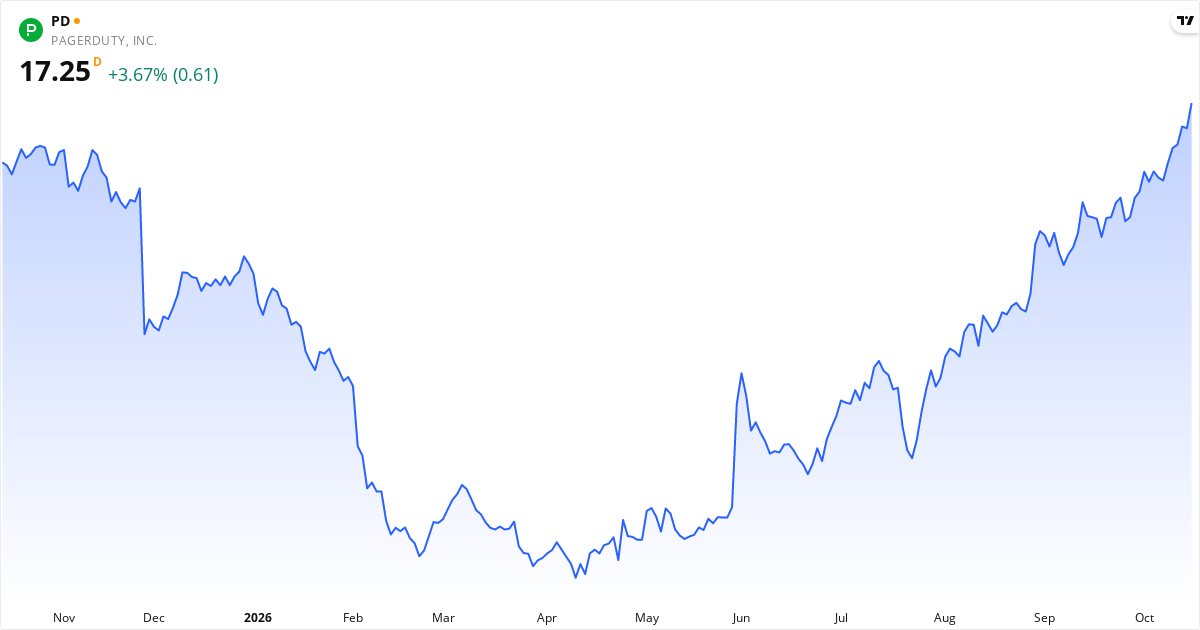
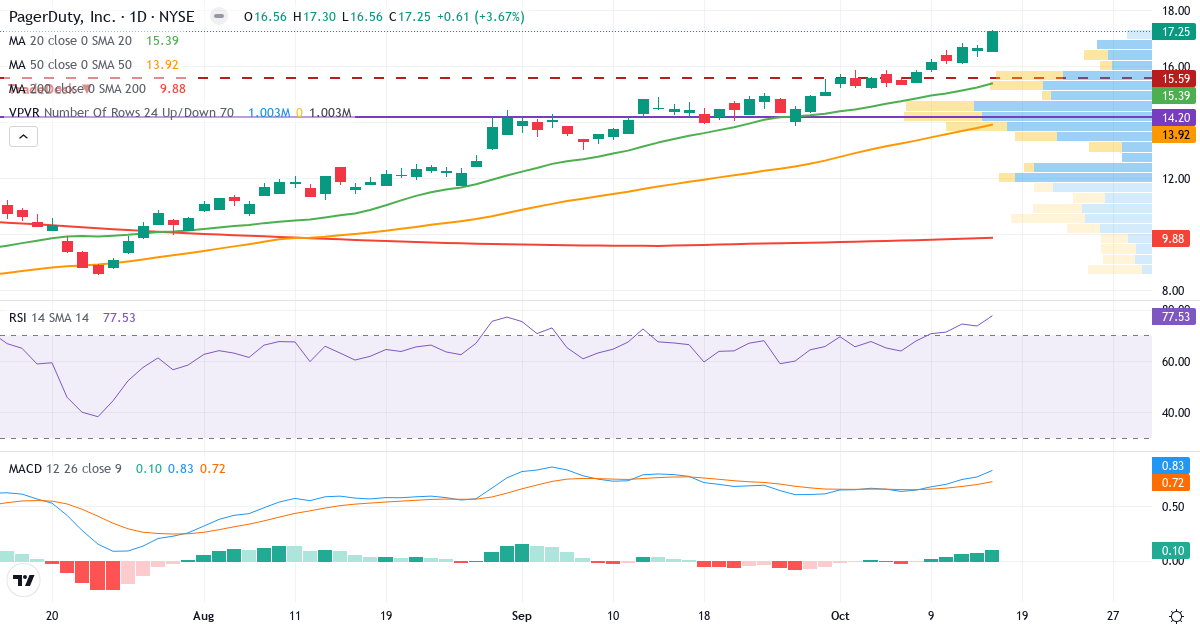
Yes, the technical signal for PagerDuty is currently Strong Buy. PagerDuty trades at $16.16 as of Oct 17, 2026. The technical analysis shows the following: MACD is positive (bullish trend) at 0.776 with rising momentum (signal: 0.735); RSI is at 60.3 (neutral zone); the stock is in a short-term uptrend (price above the 20-day average); the analyst price target of $12.64 is 21.8% below the current price. The stock is in a broader uptrend (above SMA50/SMA200). This is a technical observation based on current data, not investment advice.
What is the price target for PagerDuty stock?
The average analyst price target for PagerDuty is $12.64. The current price is $16.16, which gives a downside of 21.8%. Based on this, the stock is considered overvalued. The fair value range (±10% of the price target) is between $11.38 and $13.90.
Is PagerDuty a dividend stock?
No, PagerDuty does not currently pay a dividend to shareholders. The company reinvests its profits in growth instead of paying dividends.
What is the risk of PagerDuty stock?
PagerDuty is rated as a stock in the risk category Speculative. the annual standard deviation is 68.4%, which classifies the stock as Speculative.
Is PagerDuty overvalued?
Yes, PagerDuty is considered overvalued based on the analyst price target (21.8% above the price target). PagerDuty has the following valuation ratios: a P/E ratio of 8.1 (lowly valued), a P/S ratio of 2.6, a P/B ratio of 5.0. The analyst price target suggests that the stock is overvalued by 21.8%.
Is PagerDuty overbought?
No, PagerDuty is not overbought. RSI is at 60.3 (neutral zone). The technical indicators show: RSI is at 60.3 (upper neutral zone), which shows positive momentum but is not yet overbought. In addition, the price is 4.3% above the 20-day average (short-term uptrend). In addition, MACD is positive with rising momentum (bullish).
When is the next PagerDuty earnings report?
PagerDuty reports its next earnings on November 24, 2026. The stock currently trades at $16.16. With a P/E ratio of 8.1, the market will be watching closely whether earnings meet expectations.
Is PagerDuty shorted?
Yes, PagerDuty is shorted with 12.0% of the free float sold short. This is a very high level of short selling, which points to considerable bearish sentiment. A positive earnings report or unexpectedly good news can trigger a short squeeze with sharp price gains. The figure comes from our data provider EODHD, is reported about twice a month, and we check it every trading day.
Are insiders buying PagerDuty stock?
No, insiders are not buying PagerDuty shares – they are net sellers. Over the last 3 months, insiders have made 0 purchases and 2 sales. On a net basis, 1,736,770 $ worth of shares were sold. Across the last 20 reported transactions, the split is 0 purchases and 20 sales, with a net 20,382,326 $ sold. Active sellers include Tejada Jennifer, Solomon Dan Alexandru, Dan Alexandru Solomon and others. Insider selling can have several explanations (e.g. planned 10b5-1 sales, portfolio diversification or taxes), but sustained selling by several insiders is worth watching closely.
Is PagerDuty a good stock?
Based on our total score, PagerDuty is rated as a good stock with a total score of 77 out of 100. The stock scores above average on value, quality and momentum. The score is made up of Value: 78/100, Quality: 55/100, Momentum: 99/100. In addition: the price target is 21.8% below the current price. Whether now is the time to buy is a separate question: the technical signal is Strong Buy. Whether PagerDuty is a good investment depends on your time horizon, risk profile and portfolio. This is a data-driven observation, not investment advice.
What is the outlook for PagerDuty stock?
The outlook for PagerDuty based on current data: the average analyst price target is $12.64 (-21.8%); the stock is in an uptrend (above SMA50 and SMA200); the next earnings report is due on Nov 24, 2026, which can move the price; the P/E ratio is 8.1 (low – a possible value stock). Keep in mind that stock prices are affected by many factors, including earnings reports, the economy and market sentiment. Past returns are no guarantee of future returns.
Why is PagerDuty stock rising?
PagerDuty is rising right now. The technical indicators show: the price is 4.3% above the 20-day average; MACD is positive with rising momentum (bullish signal); short interest is 12.0% (high – many are betting on a decline); insiders have mostly been selling the stock recently. For the latest context, see our technical analysis and insider section above.
How high can PagerDuty go?
The average analyst price target for PagerDuty is $12.64, which is 21.8% below the current price of $16.16. The stock has traded between $5.70 and $16.84 over the last 52 weeks. The price is close to the 52-week high. Keep in mind that price targets are estimates, not guarantees. Actual price moves depend on earnings, market conditions and unexpected events.
How low can PagerDuty fall?
The stock has traded as low as $5.70 over the last 52 weeks — that is 64.7% below the current price of $16.16. The biggest decline (drawdown) in the same period was 66.2% from high to low. Within a year, the price typically swings about ±68.4% (standard deviation — a measure of price swings). A difficult year could therefore mean a further decline of that size. Remember: past price swings are no guarantee for the future — a stock can fall further than the last 52 weeks suggest, especially on profit warnings, sector crises or a market crash. Use stop-loss orders and spread your portfolio to limit losses in single stocks.
What does PagerDuty do?
PagerDuty makes software that helps companies manage their digital operations. It makes money by selling subscriptions to this software, which keeps watch over computer systems and devices.
The platform gathers large amounts of data and uses machine learning (a type of comput... The company belongs to the Technology sector, more specifically the Software - Application industry, is headquartered in United States, and is traded on the USA Stocks. See the key figures, earnings history and price development above to evaluate PagerDuty as an investment.
Did PagerDuty raise or lower its guidance?
Over the last 60 days we have not registered a guidance raise or cut from PagerDuty. The company can still adjust its guidance at quarterly reports or between reports — see the earnings history above.
Is PagerDuty making money or losing money?
Yes, PagerDuty is making money, not losing it. The company has a profit margin (the share of revenue left over as profit) of 37.5% — which is excellent. The operating margin (profit before interest and taxes) is 8.2%. At a P/E ratio of 8.1, you currently pay 8.1 dollars for every dollar of the company's annual earnings. A consistently profitable company is usually more resilient than growth stocks that are not yet making money.
Can PagerDuty go bankrupt?
The bankruptcy risk of PagerDuty is rated as moderate. Altman Z2 (a model for assessing financial distress) is 1.26 — that places the company in the middle zone. The Piotroski score (financial health 0-9, higher is better) is 5 — which is average. Debt relative to equity is 600% (high). Remember: models like Altman Z2 are statistical — unexpected shocks (fraud, a sector collapse, lawsuits) can always happen. Spread your portfolio.
Does PagerDuty have a lot of debt?
Yes, PagerDuty has elevated debt relative to equity. The debt-to-equity ratio (D/E — interest-bearing debt to equity) is 600%. For the technology sector, anything above 120% counts as elevated — that raises the financial risk, especially if interest rates rise or earnings fall. Tech companies are usually asset-light and need little borrowed capital — anything below 60% counts as low in this sector. Note: D/E levels are highly sector-specific — a bank at 300% debt is normal, a tech stock at 300% is extremely leveraged. Always compare with similar companies in the same sector. Can PagerDuty service its debt? Can service its debt, but it weighs on the company — the interest coverage ratio (how many times earnings can cover interest payments) is 4.9x, and net debt equals 3.9 years of earnings (EBITDA).