Energy Vault (NRGV.US) Price Target 2026/2027: 85% Upside – Rating and Stock Analysis

3,03
0,50%
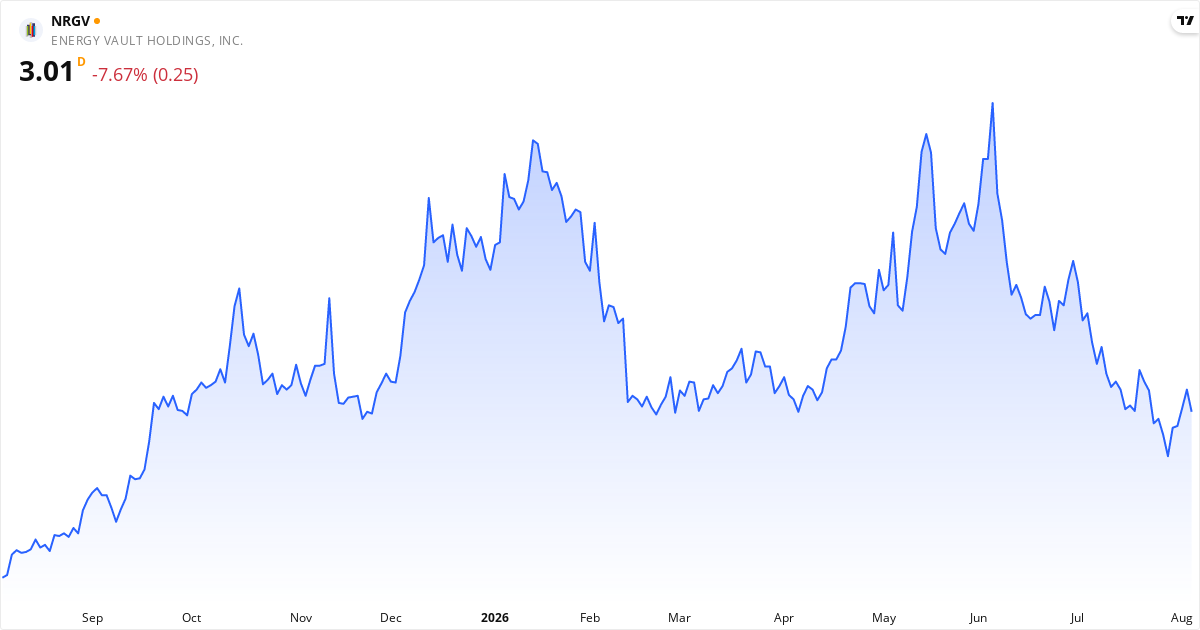
Price history for Energy Vault (NRGV.US) – stock price at 3.03 $, August 2026
Energy Vault stock price – price development 2026. Updated Aug 6, 2026.
Share this analysis:

Energy Vault Price Target 2026: Analysts See 83% Upside

The average price target for Energy Vault is $5.53. This price target represents the analysts' view of the stock price over the next 12 months. The stock may be undervalued, because the price target is higher than the current price. The stock is 82,81% below the target, which can point to potential returns within the next 12 months if the analysts' view proves right. Also consider the stock's valuation ratios such as P/E, P/S and P/B, plus the technical analysis further down the page, for the full picture.

Is Energy Vault overvalued or undervalued?

Energy Vault is currently undervalued with a gap of 82.8% relative to the price target.


The current price is $3.03, which places Energy Vault in the undervalued category. The stock is considered undervalued when the price is below $4.98, and overvalued when the price exceeds $6.08.


The fair value range is defined as ±10% of the price target, because price targets are estimates rather than exact values. For Energy Vault, the fair value range lies between $4.98 and $6.08.


See the full price target analysis for Energy Vault →

Analyst Ratings for Energy Vault stock in 2026: Buy

4 analysts cover Energy Vault. The majority is positive, with 75% recommending Buy, while 0% recommend Hold. The average price target is $5.53, which gives an upside of 82.8% from the current price.

Consensus: Buy (4.00/5)
Strong Buy
2 (50%)
Buy
1 (25%)
Sell
1 (25%)
Strong Sell Sell Hold Buy Strong Buy
4.00 out of 5 based on 4 analysts

About Energy Vault – Utilities - Renewable

Energy Vault Holdings, Inc. develops and deploys utility-scale energy storage solutions in the United States, Switzerland, United Kingdom, North America, Australia, and internationally. The company offers B-Vault, an electrochemical battery energy storage solution for short-duration energy storage needs; G-Vault, a gravity energy storage solution for long-duration energy storage needs; and H-Vault, a hydrogen or hybrid energy storage solution. It also provides software solutions, such as Vault-OS Energy Management System which provides real-time monitoring, operational control, and optimized dispatch across an array of generation and short to ultra-long duration energy storage assets; Vault-Bidder, which utilizes artificial intelligence to leverage diverse, live data from directly monitored assets and external drivers to provide dispatch and revenue optimization; and Vault-Manager, which converts diverse, real-time data into clear asset performance visibility and insights, facilitating improved decision-making regarding maintenance, augmentation, and expansion. Energy Vault Holdings, Inc. was founded in 2020 and is headquartered in Westlake Village, California. Read more about the company

Key Figures for Energy Vault

$ 591M Market cap
$ 217M Revenue
Utilities - Renewable Industry
- P/E
2.72 P/S
16.94 P/B
USA Listed on exchange

What kind of stock is Energy Vault?

Speculative stock

Energy Vault is classified as a speculative stock.

Score Overview for Energy Vault

💰 Value Score 16/100 (Very Low)
⭐ Quality Score 5/100 (Very Low)
🚀 Momentum Score 9/100 (Very Low)
📊 Total Score 10/100

⚠️ 5 red flags identified 4 critical

Our analysis has identified 5 potential risk factors in Energy Vault that investors should be aware of.

⚠️ Weak financial health: The Piotroski score is only 2/9 – the company shows signs of weakened profitability, liquidity or capital structure.
🚨 Weak balance sheet (elevated risk): Altman Z2 is -6.98 – the balance sheet is measurably weaker than average. This is a risk signal based on the numbers, not a bankruptcy prediction.
🚨 Negative profit margin: The profit margin is -53.0% – the company is losing money on its operations.
🚨 Negative return on equity: ROE is -136.3% – the company is generating a negative return for shareholders.
🚨 High short interest: 20.3% of the shares are sold short – many professional investors are betting on price declines.

📈 Valuation

The P/S ratio is 2.7. The P/B ratio is 16.9.

🏦 Financial Health

The Piotroski score is 2 out of 9 — weak financial health, be careful. Altman Z2 is -6.98 (weak balance sheet — elevated risk). The debt-to-equity ratio (D/E) is 45.6% — low debt, a solid balance sheet.

🚀 Momentum & Short Interest

Short interest is 20.27% — very high, the market is skeptical.

Insider Trading in Energy Vault 2026: The Signal Is negative

In 2026, insiders at Energy Vault have made 20 transactions – split into 9 purchases and 11 sales. On a net basis, insiders took 2,301,334 $ out of the stock. Active insiders include Piconi Robert, Mandanas Mary Beth, Thomas R Ertel and others. In the short term (last 3 months), the insider signal is negative.

Short-Term Signal (3 months): Negative

Insiders have exclusively sold shares over the last 3 months.

Over the last 3 months: 0 purchases and 4 sales. A net 1,233,333 $ out of the stock.

Long-Term Signal (all transactions): Mostly negative

Insiders have sold considerably more than they have bought. At large companies this can be due to planned sales (10b5-1 plans) and is not necessarily a negative signal.

Across the last 20 transactions: 9 purchases and 11 sales. A net 2,301,334 $ out of the stock.

Latest purchase: Piconi Robert bought 329,921 shares at 3 $ each on 2026-03-31. The stock has since fallen 6.2%.

Latest sale: Beer Michael Thomas sold 50,000 shares at 4 $ each on 2026-07-06.

Who is buying: Piconi Robert, Mandanas Mary Beth, Thomas R Ertel, Ertel Thomas R, Ladwa Akshay and others.

Who is selling: Beer Michael Thomas, Piconi Robert, Ladwa Akshay, Michael Thomas Beer.

Latest Insider Trades in Energy Vault (2026)

The table shows the last 20 reported insider transactions in Energy Vault. Green rows are purchases, red rows are sales. The data is based on official filings.

Transaction date Name Type Number of shares Price per share ($) Total amount ($)
2026-07-06 Beer Michael Thomas Sell 50,000 4 204,000
2026-06-30 Piconi Robert Sell 141,682 5 667,322
2026-06-30 Ladwa Akshay Sell 52,721 5 248,316
2026-06-30 Beer Michael Thomas Sell 24,139 5 113,695
2026-04-06 Michael Thomas Beer Sell 65,000 3 206,700
2026-04-06 Beer Michael Thomas Sell 50,000 3 159,000
2026-03-31 Piconi Robert Buy 329,921 3 1,059,046
2026-03-31 Ladwa Akshay Sell 147,984 3 488,347
2026-03-31 Beer Michael Thomas Sell 28,738 3 94,835
2026-03-25 Mandanas Mary Beth Buy 5,000 4 18,250

Who is buying and selling Energy Vault shares in 2026?

The following insiders have bought shares in Energy Vault: Piconi Robert, Mandanas Mary Beth, Thomas R Ertel, Ertel Thomas R, Ladwa Akshay and others. In total, 1,203,284 $ was bought across 9 transactions. The following insiders have sold shares: Beer Michael Thomas, Piconi Robert, Ladwa Akshay, Michael Thomas Beer. In total, 3,504,618 $ was sold across 11 transactions. Insider trades are legal transactions in which executives and board members buy or sell shares of their own company. These transactions are reported to the SEC and are publicly available.

Energy Vault Short Selling 2026: 20.3% Sold Short

Extremely shorted: 20.3% of the free float
Short % of free float
20.3%
Assessment
Extremely shorted
Short squeeze risk
Very High
Data source
SEC
Updated daily
The stock has an extremely high share of short selling. More than 20% of the freely traded shares are sold short, which is unusual and can point to great skepticism among institutional investors. The risk of a short squeeze on positive news is considerable.

What does this mean for you as an investor?
A short interest of 20.3% means that 20.3% of the freely traded shares in Energy Vault have been borrowed and sold by investors betting on falling prices. On positive surprises (e.g. a strong earnings report), short sellers can be forced to buy back shares quickly to close their positions, which can cause a short squeeze with sharp price gains in a short time.

The next potential catalyst is the earnings report on 8/11/2026. With a short interest of 20.3%, the report can trigger considerable volatility.

Data is updated daily based on official filings with the SEC.
Short Interest Scale
0% 2% 5% 10% 20%+
Low Moderate High Very High Extreme
20.3%

When Does Energy Vault Report Earnings – Next Date: 8/11/2026

The next earnings report from Energy Vault is scheduled for August 11, 2026, after the market closes. This report covers the second quarter (Q2), which ended on June 30, 2026.


Technical Analysis of Energy Vault 2026 – Signal: Strong Sell

Overall Technical Signal: Strong Sell

Based on trend analysis (SMA50/SMA200) and MACD trend (positive/negative on a daily + weekly basis). Updated August 6, 2026.

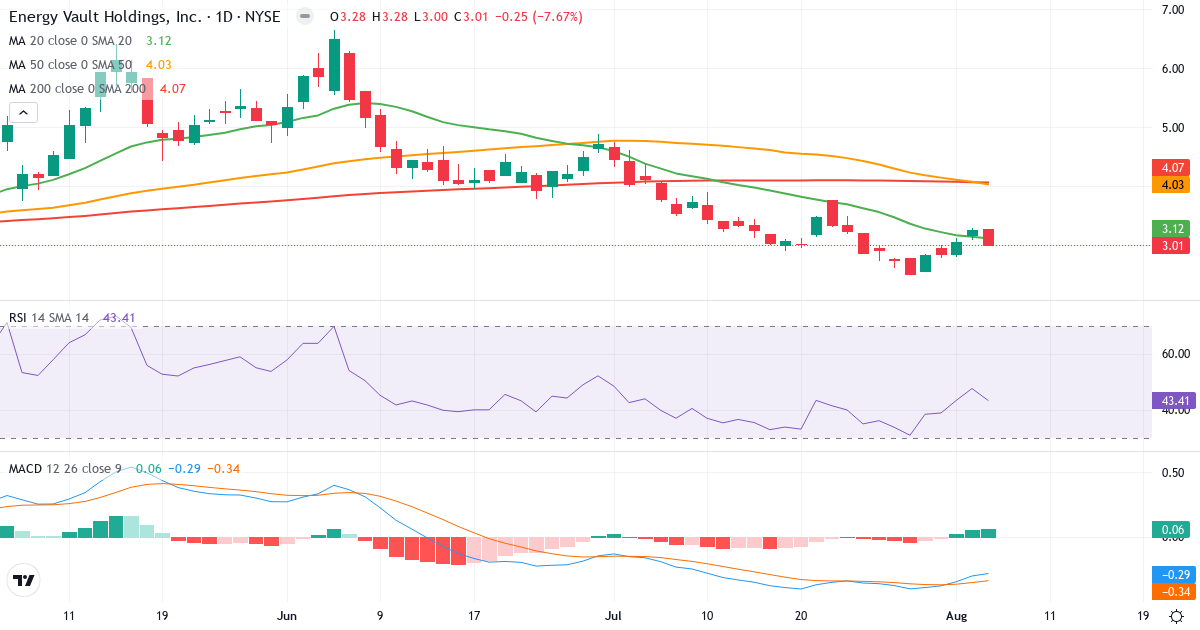
Technical analysis of Energy Vault (NRGV.US) – RSI 43, MACD negative (bearish), daily candlestick chart August 2026
Energy Vault technical analysis – candlestick chart with RSI and MACD. Updated Aug 6, 2026.

Trend Analysis of Energy Vault Holdings Inc

Energy Vault Holdings Inc is in a short-term downtrend. The price of $3.01 is 3.5% below the 20-day average ($3.12). Medium term, the picture is negative: the price is 25.4% below the 50-day average ($4.04). Long term, the stock is 26.0% below the 200-day average ($4.07), which signals a long-term downtrend.

Death Cross: The 50-day average (4.04) is below the 200-day average (4.07), which is a classic bearish signal for Energy Vault Holdings Inc.

Is Energy Vault Holdings Inc overbought or oversold?

Energy Vault Holdings Inc has an RSI of 43.4. The stock sits in the lower part of the neutral zone, which points to weak momentum without being oversold. In the current downtrend, be careful about reading this as a buying opportunity.

MACD Analysis for Energy Vault Holdings Inc

Daily MACD: MACD is negative (-0.286), which means the short-term trend is bearish (the 12-day EMA is below the 26-day EMA). MACD is above the signal line (-0.342) by 0.056, which suggests the negative momentum is fading – a potential trend reversal could be ahead.

Weekly MACD: MACD5 is negative (-0.114), which indicates a broader bearish long-term trend. MACD5 is below the signal line (0.150) by 0.264, which confirms continued negative long-term momentum.

Overall MACD assessment: Both the daily and weekly trend are bearish (MACD negative). However, momentum shows signs of improving on a daily basis – a potential trend reversal could be ahead, but it is not confirmed yet.

Risk Profile for Energy Vault Holdings Inc

Energy Vault Holdings Inc has an annual standard deviation of 106.4%, which classifies the stock as extreme risk. Only risk-tolerant investors should consider this stock, because the price swings can be very large.

Overall Technical Conclusion for Energy Vault Holdings Inc

Trend: Negative. The price trades below SMA50 and SMA200.

MACD trend (zero line): Daily bearish (-0.286). Weekly bearish (-0.114).

MACD momentum (signal): Daily rising. Weekly falling.

RSI: 43.4 – neutral.

Technical signal: Strong Sell

The price is in a downtrend (below SMA50/SMA200) and MACD is negative on both a daily and weekly basis. Avoid buying and consider closing existing positions.

Frequently Asked Questions About Energy Vault stock in 2026

Should you buy Energy Vault stock now?
No, the technical signal for Energy Vault is currently SELL. Energy Vault trades at $3.03 as of 8/6/2026. The overall technical signal is: Strong Sell. The technical analysis shows the following: MACD is negative (bearish trend) at -0.286 with rising momentum (signal: -0.342); RSI is at 43.4 (neutral zone); the stock is in a short-term downtrend (price below the 20-day average); the analyst price target of $5.53 points to 82.8% upside. The stock is in a broader downtrend (below SMA50/SMA200). Buying in a downtrend is generally not recommended. This is a technical observation based on current data, not investment advice.
What is the price target for Energy Vault stock?
The average analyst price target for Energy Vault is $5.53. The current price is $3.03, which gives an upside of 82.8%. Based on this, the stock is considered undervalued. The fair value range (±10% of the price target) is between $4.98 and $6.08.
Is Energy Vault a dividend stock?
No, Energy Vault does not currently pay a dividend to shareholders. The company reinvests its profits in growth instead of paying dividends.
What is the risk of Energy Vault stock?
Energy Vault is rated as a stock with extreme risk. the annual standard deviation is 106.4%, which classifies the stock as extreme risk.
Is Energy Vault overvalued?
No, Energy Vault is considered undervalued based on the analyst price target (82.8% upside). Energy Vault has the following valuation ratios: a P/S ratio of 2.7, a P/B ratio of 16.9. The analyst price target suggests that the stock is undervalued by 82.8%.
Is Energy Vault overbought?
No, Energy Vault is not overbought. RSI is at 43.4 (neutral zone). The technical indicators show: RSI is at 43.4 (neutral zone between 30-70), which signals neither overbought nor oversold. In addition, the price is 3.0% below the 20-day average (short-term downtrend). In addition, MACD is negative, but momentum is rising (possible trend reversal).
When is the next Energy Vault earnings report?
Energy Vault reports its next earnings on August 11, 2026. The stock currently trades at $3.03.
Is Energy Vault shorted?
Yes, Energy Vault is shorted with 20.3% of the free float sold short. This is an extremely high level of short selling, which points to great skepticism among institutional investors. The risk of a short squeeze on positive news or earnings is very high. Data is updated daily based on official filings with the SEC.
Are insiders buying Energy Vault stock?
No, insiders are not buying Energy Vault shares – they are net sellers. Over the last 3 months, insiders have made 0 purchases and 4 sales. On a net basis, 1,233,333 $ worth of shares were sold. Across the last 20 reported transactions, the split is 9 purchases and 11 sales, with a net 2,301,334 $ sold. Active sellers include Beer Michael Thomas, Piconi Robert, Ladwa Akshay and others. Insider selling can have several explanations (e.g. planned 10b5-1 sales, portfolio diversification or taxes), but sustained selling by several insiders is worth watching closely.
Is Energy Vault a good stock?
Based on our total score, Energy Vault is rated as a disastrous stock with a total score of 10 out of 100. The stock scores very low on value, quality and momentum – it is among the worst in our database. The score is made up of Value: 16/100, Quality: 5/100, Momentum: 9/100. In addition: analysts see 82.8% upside to the price target; technical signal: Strong Sell. Whether Energy Vault is a good investment depends on your time horizon, risk profile and portfolio. This is a data-driven observation, not investment advice.
What is the outlook for Energy Vault stock?
The outlook for Energy Vault based on current data: the average analyst price target is $5.53 (+82.8%); the stock is in a downtrend (below SMA50 and SMA200); the next earnings report is due on 8/11/2026, which can move the price. Keep in mind that stock prices are affected by many factors, including earnings reports, the economy and market sentiment. Past returns are no guarantee of future returns.
Why is Energy Vault stock falling?
Energy Vault is falling right now. The technical indicators show: the price is 3.0% below the 20-day average; short interest is 20.3% (high – many are betting on a decline); insiders have mostly been selling the stock recently. For the latest context, see our technical analysis, insider section and news overview above.
How high can Energy Vault go?
The average analyst price target for Energy Vault is $5.53, which corresponds to a potential gain of 82.8% from the current price of $3.03. Keep in mind that price targets are estimates, not guarantees. Actual price moves depend on earnings, market conditions and unexpected events.
How low can Energy Vault fall?
We lack enough history to give a specific floor for Energy Vault. Remember: past price swings are no guarantee for the future — a stock can fall further than the last 52 weeks suggest, especially on profit warnings, sector crises or a market crash. Use stop-loss orders and spread your portfolio to limit losses in single stocks.
What does Energy Vault do?
Energy Vault Holdings, Inc. develops and deploys utility-scale energy storage solutions in the United States, Switzerland, United Kingdom, North America, Australia, and internationally. The company offers B-Vault, an electrochemical battery energy storage solution for short-du... The company belongs to the Forsyning sector, more specifically the Utilities - Renewable industry, is headquartered in USA, and is traded on the USA Stocks. See the key figures, earnings history and price development above to evaluate Energy Vault as an investment.
Did Energy Vault raise or lower its guidance?
Over the last 60 days we have not registered a guidance raise or cut from Energy Vault. The company can still adjust its guidance at quarterly reports or between reports — see the earnings history and the news overview above.
Is Energy Vault making money or losing money?
No, Energy Vault is currently not making money — the company is losing money with a negative profit margin of -53.0%, a substantial loss. That means the business loses money on every dollar of revenue. For growth stocks investing in expansion this is normal — but it raises the risk if the company does not reach break-even before its capital runs out.
Can Energy Vault go bankrupt?
The bankruptcy risk of Energy Vault is rated as elevated. Altman Z2 (a model for assessing financial distress) is -6.98 — that places the company in the weak zone. This is a probability based on the numbers, not a verdict — bankruptcy is not imminent. But the balance sheet is measurably weaker than average, so watch the debt, liquidity and possible capital raises. The Piotroski score (financial health 0-9, higher is better) is 2 — which is weak. Debt relative to equity is 46% (low). Remember: models like Altman Z2 are statistical — unexpected shocks (fraud, a sector collapse, lawsuits) can always happen. Spread your portfolio.
Does Energy Vault have a lot of debt?
No, Energy Vault has low debt relative to equity. The debt-to-equity ratio (D/E — interest-bearing debt to equity) is 46%. For the forsyning sector, anything below 80% counts as low debt. Note: D/E levels are highly sector-specific — a bank at 300% debt is normal, a tech stock at 300% is extremely leveraged. Always compare with similar companies in the same sector.