DoorDash (DASH.US) Price Target 2026/2027: 30% Upside – Rating and Stock Analysis

193.50
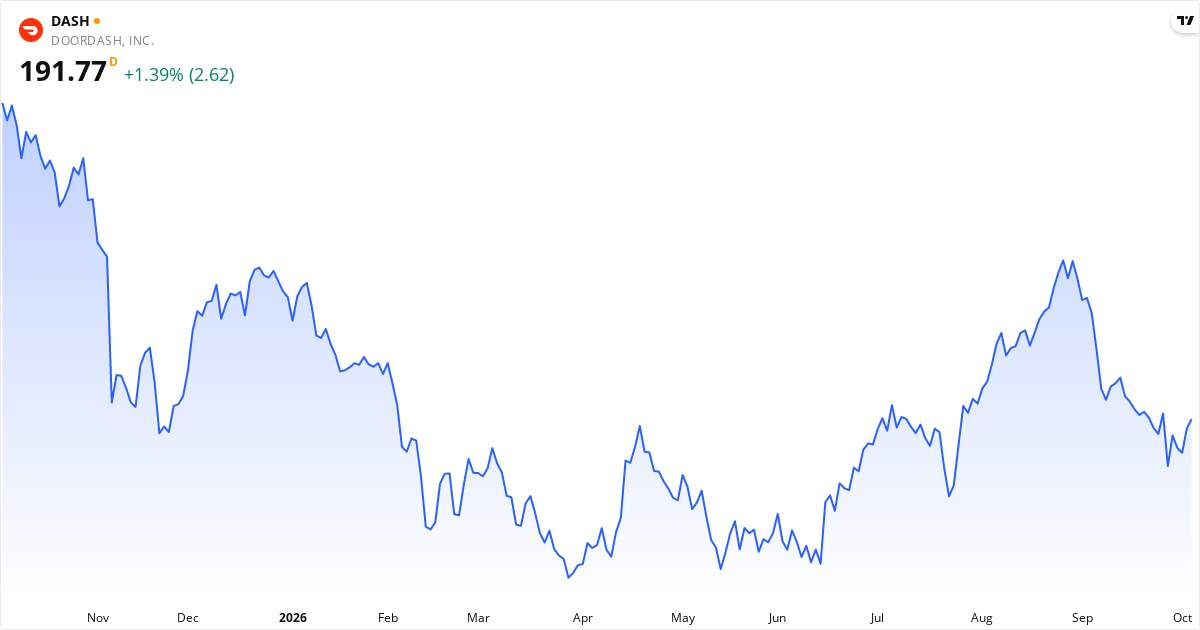
Price history for DoorDash (DASH.US) – stock price at $193.50, October 2026
DoorDash stock price – price development 2026. Updated Oct 7, 2026.
Share this analysis:

DoorDash Price Target 2026: Analysts See 32% Upside

The average price target for DoorDash is $256.26. This price target represents the analysts' view of the stock price over the next 12 months. The stock may be undervalued, because the price target is higher than the current price. The stock is 32.43% below the target, which can point to potential returns within the next 12 months if the analysts' view proves right. Also consider the stock's valuation ratios such as P/E, P/S and P/B, plus the technical analysis further down the page, for the full picture.

Is DoorDash overvalued or undervalued?

DoorDash is currently undervalued with a gap of 32.4% relative to the price target.


The current price is $193.50, which places DoorDash in the undervalued category. The stock is considered undervalued when the price is below $230.63, and overvalued when the price exceeds $281.89.


The fair value range is defined as ±10% of the price target, because price targets are estimates rather than exact values. For DoorDash, the fair value range lies between $230.63 and $281.89.


See the full price target analysis for DoorDash →

Analyst Ratings for DoorDash stock in 2026: Buy

41 analysts cover DoorDash. The majority is positive, with 68.3% recommending Buy, while 31.7% recommend Hold. The average price target is $256.26, which gives an upside of 32.4% from the current price.

Consensus: Buy (4.17/5)
Strong Buy
20 (48.8%)
Buy
8 (19.5%)
Hold
13 (31.7%)
Strong Sell Sell Hold Buy Strong Buy
4.17 out of 5 based on 41 analysts

About DoorDash – Internet Retail

DoorDash connects restaurants, shoppers, and delivery drivers. The company earns money by helping businesses find customers, deliver goods, and handle payments.

**Main markets and customers**

DoorDash operates in the United States and internationally. Its main products are two large marketplaces: DoorDash and Wolt. These platforms connect restaurants and stores with customers who want food or goods delivered, and with drivers who deliver them.

**Other products and services**

- DashPass and Wolt+ are paid membership programs. Customers pay a regular fee to get benefits such as lower delivery costs.
- DoorDash Drive and Wolt Drive are "white-label" delivery services. This means other companies can use DoorDash's delivery network under their own brand name, without customers seeing the DoorDash or Wolt name.
- Bbot is a digital ordering product that lets customers order and pay through their phone, for example at a restaurant table or a hotel.

**Company background**

DoorDash was founded in 2013. The company is headquartered in San Francisco, United States.
Read more about the company

Key Figures for DoorDash

$81.1B Market cap
$15.9B Revenue
Internet Retail Industry
93.55 P/E
5.10 P/S
8.27 P/B
United States Listed on exchange

What kind of stock is DoorDash?

Speculative stock

DoorDash is classified as a speculative stock.

Score Overview for DoorDash

💰 Value Score 15/100 (Very Low)
⭐ Quality Score 50/100 (Neutral)
🚀 Momentum Score 38/100 (Low)
📊 Total Score 34/100

⚠️ 1 red flag identified

Our analysis has identified 1 potential risk factor in DoorDash that investors should be aware of.

⚠️ Falling earnings: Quarterly earnings have fallen 30% year over year – the company's profitability is under pressure.

📈 Valuation

DoorDash trades at a P/E ratio of 93.6, which is above the market average. The forward P/E is 38.0 (59% lower), which suggests the market expects rising earnings. The P/S ratio is 5.1 (high — the market pays a premium for the revenue). The P/B ratio is 8.3. The PEG ratio is 1.05.

💵 Profitability & Growth

DoorDash has a profit margin of 5.3% (moderate) and an operating margin of 3.9%. Return on equity (ROE) is 8.9%. Return on assets (ROA) is 3.0%. The latest quarterly earnings grew -30.0% year over year — falling earnings.

🏦 Financial Health

The Piotroski score is 7 out of 9 — good financial health. Altman Z2 is 1.31 (middle zone — moderate). The debt-to-equity ratio (D/E) is 64.5% — low debt, a solid balance sheet.

🚀 Momentum & Short Interest

Short interest is 4.01%.

Insider Trading in DoorDash 2026: The Signal Is negative

In 2026, insiders at DoorDash have made 20 transactions, all of which were sales. On a net basis, insiders took $43,739,090 out of the stock. Active insiders include Yandell Keith, Fang Andy, Adarkar Prabir and others. In the short term (last 3 months), the insider signal is negative.

Short-Term Signal (3 months): Negative

Insiders have exclusively sold shares over the last 3 months.

Over the last 3 months: 0 purchases and 20 sales. A net $43,739,090 out of the stock.

Long-Term Signal (all transactions): Negative

Insiders have exclusively sold shares in the recent period. This can suggest management sees limited opportunity.

Across the last 20 transactions: 0 purchases and 20 sales. A net $43,739,090 out of the stock.

Latest sale: Yandell Keith sold 2,183 shares at $183.69 each on 2026-10-01.

Who is selling: Yandell Keith, Fang Andy, Adarkar Prabir, Lee Gordon S, Tang Stanley and others.

Latest Insider Trades in DoorDash (2026)

The table shows the last 20 reported insider transactions in DoorDash. Green rows are purchases, red rows are sales. The data is based on official filings.

Transaction date Name Type Number of shares Price per share ($) Total amount ($)
2026-10-01 Yandell Keith Sell 2,183 184 400,995
2026-10-01 Fang Andy Sell 5,000 184 918,450
2026-09-28 Adarkar Prabir Sell 1,638 190 311,842
2026-09-17 Yandell Keith Sell 2,184 201 438,460
2026-09-04 Lee Gordon S Sell 413 222 91,480
2026-09-02 Tang Stanley Sell 30,835 227 7,006,637
2026-09-01 Xu Tony Sell 16,667 230 3,833,410
2026-09-01 Inukonda Ravi Sell 1,017 232 236,147
2026-09-01 Fang Andy Sell 15,000 232 3,483,450
2026-08-25 Xu Tony Sell 3,767 230 866,410

Who is buying and selling DoorDash shares in 2026?

The following insiders have sold shares: Yandell Keith, Fang Andy, Adarkar Prabir, Lee Gordon S, Tang Stanley and others. In total, $43,739,090 was sold across 20 transactions. Insider trades are legal transactions in which executives and board members buy or sell shares of their own company. These transactions are reported to the SEC and are publicly available.

DoorDash Short Selling 2026: 4.0% Sold Short

Moderate short interest: 4.0% of the free float
Short % of free float
4.0%
Assessment
Moderate short interest
Short squeeze risk
Low
Data source
EODHD
Reported about twice a month

Short interest over time: DoorDash

0.0%3.0%6.0%
Peak 5.2% · 7/13
5/307/3110/1
4.0% today (moderate)Peaked at 5.2% on Jul 13, 2026Essentially unchanged over the last 30 daysMeasured over 124 days
What does the trend tell you?
Short interest has been markedly higher. It peaked at 5.2% on Jul 13, 2026 and now stands at 4.0% — a fall of 1.2 percentage points. Over the last month it has been fairly stable.

This is how shorting works: whoever shorts has borrowed the share and sold it, and to close the position again they must buy the share back. The fall from the peak therefore means that those who bet on a falling price in DoorDash have bought shares back and closed their positions. It is worth watching whether the curve stays there or turns again. That is not in itself a signal about what the price will do — we cannot predict the market, and short interest is only one number among many. But it does say something about what the large players are doing.
The stock has a moderate share of short selling. Between 2-5% of the freely traded shares are sold short, which is within the normal range for most stocks.

Short interest comes from our data provider EODHD. The figure is reported about twice a month; we check it every trading day.
Short Interest Scale
0% 2% 5% 10% 20%+
Low Moderate High Very High Extreme
▲
4.0%

When Does DoorDash Report Earnings – Next Date: Nov 4, 2026

The next earnings report from DoorDash is scheduled for November 4, 2026, after the market closes. This report covers the third quarter (Q3), which ended on September 30, 2026.


Technical Analysis of DoorDash 2026 – Signal: Hold

Overall Technical Signal: Hold

Based on trend analysis (SMA50/SMA200) and MACD trend (positive/negative on a daily + weekly basis). Updated October 7, 2026.

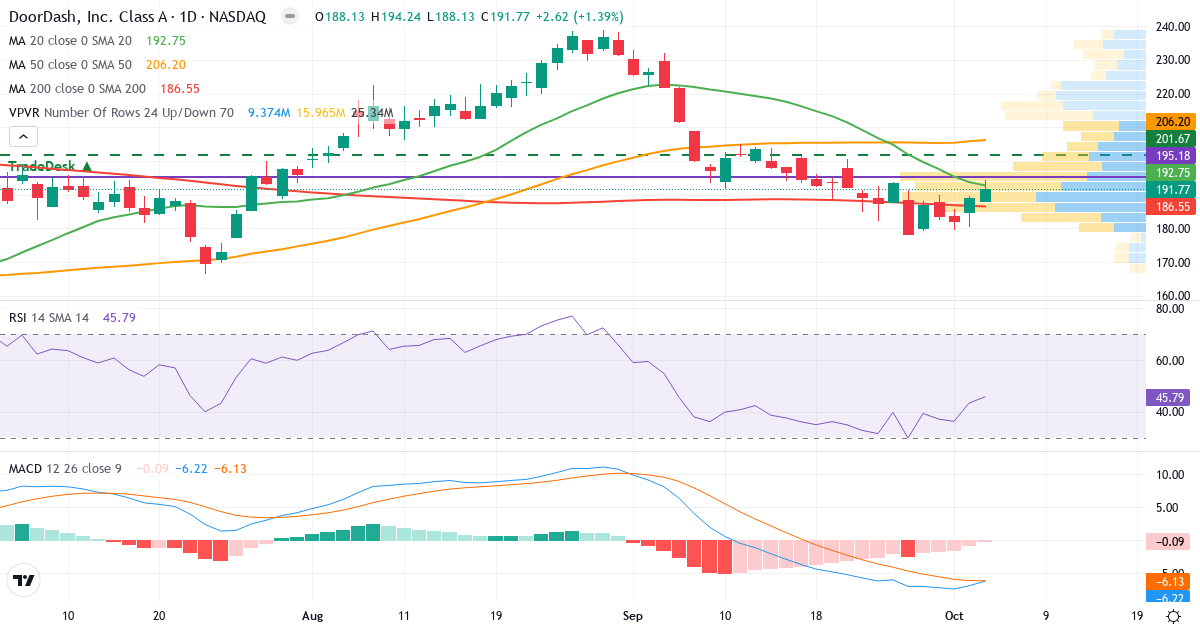
Technical analysis of DoorDash (DASH.US) – RSI 48, MACD negative (bearish), daily candlestick chart October 2026
DoorDash technical analysis – candlestick chart with RSI, MACD and volume profile. Updated Oct 7, 2026.

Trend Analysis of DoorDash, Inc

DoorDash, Inc is in a short-term uptrend. The price of $193.62 is 0.6% above the 20-day average ($192.41). Medium term, the picture is negative: the price is 6.2% below the 50-day average ($206.39). Long term, the stock is 3.9% above the 200-day average ($186.41), which confirms a long-term uptrend.

Golden Cross: The 50-day average (206.39) is above the 200-day average (186.41), which is a classic bullish signal for DoorDash, Inc.

Is DoorDash, Inc overbought or oversold?

DoorDash, Inc has an RSI of 47.5, right in the middle of the neutral zone. There is no clear buying or selling pressure.

MACD Analysis for DoorDash, Inc

Daily MACD: MACD is negative (-5.477), which means the short-term trend is bearish (the 12-day EMA is below the 26-day EMA). MACD is above the signal line (-6.003) by 0.526, which suggests the negative momentum is fading – a potential trend reversal could be ahead.

Weekly MACD: MACD5 is positive (3.847), which indicates a broader bullish long-term trend. MACD5 is above the signal line (3.795) by 0.052, which confirms rising long-term momentum.

Overall MACD assessment: The daily and weekly MACD give conflicting signals. The long-term trend is bullish, but the short-term trend is bearish. Daily momentum is rising, though, which could suggest the pullback is over.

Risk Profile for DoorDash, Inc

DoorDash, Inc has an annual standard deviation of 48.3%, which classifies the stock as medium risk. The price can swing noticeably when the market moves.

Overall Technical Conclusion for DoorDash, Inc

Trend: Neutral/mixed.

MACD trend (zero line): Daily bearish (-5.477). Weekly bullish (3.847).

MACD momentum (signal): Daily rising. Weekly rising.

RSI: 47.5 – neutral.

Technical signal: Hold

The signals are mixed – trend and MACD point in different directions. Wait until MACD crosses the zero line in the direction of the trend before acting.

Frequently Asked Questions About DoorDash stock in 2026

Should you buy DoorDash stock now?
The technical signal for DoorDash is currently Hold. DoorDash trades at $193.50 as of Oct 7, 2026. The technical analysis shows the following: MACD is negative (bearish trend) at -5.477 with rising momentum (signal: -6.003); RSI is at 47.5 (neutral zone); the stock is in a short-term uptrend (price above the 20-day average); the analyst price target of $256.26 points to 32.4% upside. This is a technical observation based on current data, not investment advice.
What is the price target for DoorDash stock?
The average analyst price target for DoorDash is $256.26. The current price is $193.50, which gives an upside of 32.4%. Based on this, the stock is considered undervalued. The fair value range (±10% of the price target) is between $230.63 and $281.89.
Is DoorDash a dividend stock?
No, DoorDash does not currently pay a dividend to shareholders. The company reinvests its profits in growth instead of paying dividends.
What is the risk of DoorDash stock?
DoorDash is rated as a stock in the risk category Moderate. the annual standard deviation is 48.3%, which classifies the stock as Moderate.
Is DoorDash overvalued?
No, DoorDash is considered undervalued based on the analyst price target (32.4% upside). DoorDash has the following valuation ratios: a P/E ratio of 93.6 (highly valued), a P/S ratio of 5.1, a P/B ratio of 8.3. The analyst price target suggests that the stock is undervalued by 32.4%.
Is DoorDash overbought?
No, DoorDash is not overbought. RSI is at 47.5 (neutral zone). The technical indicators show: RSI is at 47.5 (neutral zone between 30-70), which signals neither overbought nor oversold. In addition, the price is 0.6% above the 20-day average (short-term uptrend). In addition, MACD is negative, but momentum is rising (possible trend reversal).
When is the next DoorDash earnings report?
DoorDash reports its next earnings on November 4, 2026. The stock currently trades at $193.50. With a P/E ratio of 93.6, the market will be watching closely whether earnings meet expectations.
Is DoorDash shorted?
Yes, DoorDash is shorted with 4.0% of the free float sold short. This is a moderate level of short selling, within the normal range for most stocks. The figure comes from our data provider EODHD, is reported about twice a month, and we check it every trading day.
Are insiders buying DoorDash stock?
No, insiders are not buying DoorDash shares – they are net sellers. Over the last 3 months, insiders have made 0 purchases and 20 sales. On a net basis, 43,739,090 $ worth of shares were sold. Across the last 20 reported transactions, the split is 0 purchases and 20 sales, with a net 43,739,090 $ sold. Active sellers include Yandell Keith, Fang Andy, Adarkar Prabir and others. Insider selling can have several explanations (e.g. planned 10b5-1 sales, portfolio diversification or taxes), but sustained selling by several insiders is worth watching closely.
Is DoorDash a good stock?
Based on our total score, DoorDash is rated as a poor stock with a total score of 34 out of 100. The stock scores below average on value, quality and momentum – it sits at the lower end of the market. The score is made up of Value: 15/100, Quality: 50/100, Momentum: 38/100. In addition: analysts see 32.4% upside to the price target; technical signal: Hold. Whether DoorDash is a good investment depends on your time horizon, risk profile and portfolio. This is a data-driven observation, not investment advice.
What is the outlook for DoorDash stock?
The outlook for DoorDash based on current data: the average analyst price target is $256.26 (+32.4%); the next earnings report is due on Nov 4, 2026, which can move the price; the P/E ratio is 93.6 (high – the market expects growth). Keep in mind that stock prices are affected by many factors, including earnings reports, the economy and market sentiment. Past returns are no guarantee of future returns.
Why is DoorDash stock moving?
DoorDash is stable right now. The technical indicators show: the price is close to the 20-day average; insiders have mostly been selling the stock recently. For the latest context, see our technical analysis and insider section above.
How high can DoorDash go?
The average analyst price target for DoorDash is $256.26, which corresponds to a potential gain of 32.4% from the current price of $193.50. The stock has traded between $143.30 and $285.50 over the last 52 weeks. The price is 32.2% below the 52-week high, which can indicate potential if the underlying fundamentals are intact. Keep in mind that price targets are estimates, not guarantees. Actual price moves depend on earnings, market conditions and unexpected events.
How low can DoorDash fall?
The stock has traded as low as $143.30 over the last 52 weeks — that is 25.9% below the current price of $193.50. The biggest decline (drawdown) in the same period was 49.8% from high to low. Within a year, the price typically swings about ±48.3% (standard deviation — a measure of price swings). A difficult year could therefore mean a further decline of that size. Remember: past price swings are no guarantee for the future — a stock can fall further than the last 52 weeks suggest, especially on profit warnings, sector crises or a market crash. Use stop-loss orders and spread your portfolio to limit losses in single stocks.
What does DoorDash do?
DoorDash connects restaurants, shoppers, and delivery drivers. The company earns money by helping businesses find customers, deliver goods, and handle payments. **Main markets and customers** DoorDash operates in the United States and internationally. Its main products are t... The company belongs to the Communication Services sector, more specifically the Internet Retail industry, is headquartered in United States, and is traded on the USA Stocks. See the key figures, earnings history and price development above to evaluate DoorDash as an investment.
Did DoorDash raise or lower its guidance?
Over the last 60 days we have not registered a guidance raise or cut from DoorDash. The company can still adjust its guidance at quarterly reports or between reports — see the earnings history above.
Is DoorDash making money or losing money?
Yes, DoorDash is making money, not losing it. The company has a profit margin (the share of revenue left over as profit) of 5.3% — which is moderate. The operating margin (profit before interest and taxes) is 3.9%. At a P/E ratio of 93.6, you currently pay 93.6 dollars for every dollar of the company's annual earnings. A consistently profitable company is usually more resilient than growth stocks that are not yet making money.
Can DoorDash go bankrupt?
The bankruptcy risk of DoorDash is rated as moderate. Altman Z2 (a model for assessing financial distress) is 1.31 — that places the company in the middle zone. The Piotroski score (financial health 0-9, higher is better) is 7 — which is strong. Debt relative to equity is 65% (moderate). Remember: models like Altman Z2 are statistical — unexpected shocks (fraud, a sector collapse, lawsuits) can always happen. Spread your portfolio.
Does DoorDash have a lot of debt?
No, DoorDash has low debt relative to equity. The debt-to-equity ratio (D/E — interest-bearing debt to equity) is 65%. For the communication services sector, anything below 80% counts as low debt. Telecom and media companies invest moderately in infrastructure — 80-150% is a typical level. Note: D/E levels are highly sector-specific — a bank at 300% debt is normal, a tech stock at 300% is extremely leveraged. Always compare with similar companies in the same sector.
Other Stocks in Communication Services

Compare DoorDash with other stocks in the communication services sector. Click a stock to see its technical analysis, insider trading and key figures.

See all 34 stocks in the Communication Services sector